Clew — impact analysis over the lineage Nextflow already writes
tooling - Barcelona
Goal
Run Clew on real Nextflow production or research runs from participants and see how it behaves. I am also planning to add more report adapters for nf-core pipelines. I want to collect feedback on whether this model matches how labs actually work, and if it is useful for the intended users.
Description
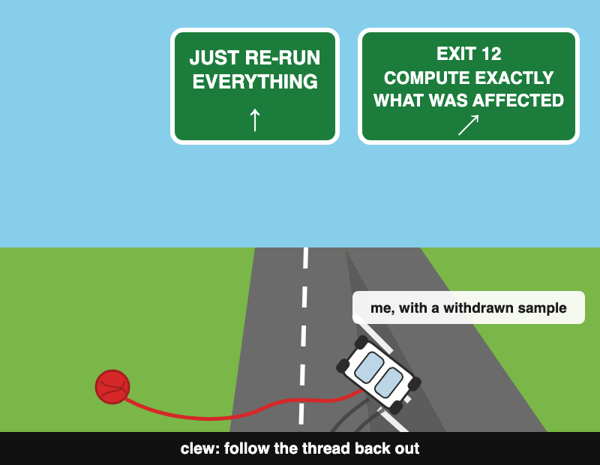
There are cases where an input turns out to be defective long after the run finished: a container had a bug, a sample failed QC after its data was already used somewhere downstream, or a reference genome got updated. The usual action is to rerun the current pipeline with the -resume command, but it doesn’t tell you which older runs used the defective input, which tasks consumed its outputs, or what to delete, re-run and disclose.
Clew tries to answer these questions with evidence: it builds a DAG from the existing data lineage store, nf-prov RO-Crates, or work/ symlinks, and provides an impact analysis with a remediation plan. Verdicts reference the policy rule they came from and can be recomputed offline. It also follows links between pipelines, e.g. a withdrawn sample in an rnaseq run ends up in the differentialabundance run that read its count matrix.
Try it in two minutes:
pip install clew-lineageclew demoStdlib only, AGPL: https://github.com/QuietFlare/clew
What participants will do
The project has something for every level:
- Run the extractors on your own runs and report what breaks (no coding).
- Tell us how samples really become unrecoverable in your lab (no coding, most valuable).
- Add an adapter for a pipeline you use (40 to 60 lines of Python).
- Extend the trigger selectors.
- Take on the hard one and give the event log an identity.